

A featured contribution from Leadership Perspectives: a curated forum reserved for leaders nominated by our subscribers and vetted by the Construction Tech Review Advisory Board.

SAP
To Cloud or not to Cloud: No Longer a Question
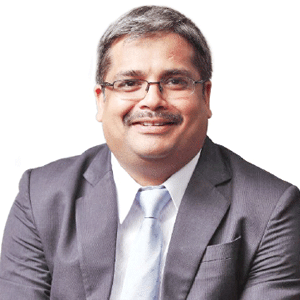
Dilipkumar Khandelwal
Analysts confirm that the worldwide cloud computing market leaped by 28 percent to 110B USD in revenues in 2015, a clear validation of its rapid growth. While going the cloud way is no longer a topic for debate and deliberation, CIO’s across enterprises have to deal with challenges while implementing the various cloud propositions they can choose from.
Presently, the most favoured cloud software option for the Enterprises is Software as a Service (SaaS) and hence it’s rapid growth. By 2020 the expected penetration of software as a service (SaaS) versus traditional software deployment is over 25 percent. Customers adore this model as it gives them freedom from hardware management, associated upgrades and software life cycle problems. In simple words, the customer needs only an internet connection for the solution to work. On purchase of subscription, the enterprise gets user logins through which users can access the application after system configuration.
The beauty of this model is in the simplicity of implementation and use. Business configurations are simple as most of it is taken care of by application of best practices. This results in minimum implementation times and faster go-lives. However, the model comes with its own challenges. The simplicity of implementation creates a lack of flexibility which many of the customers demand owing to variation in operating models. Today, the best of SaaS providers face challenges related to extensibility and customer specific enhancements which limit the scalability of complex business critical applications for large businesses. This is a gap that the software providers are working on at a war-like pace because SaaS is the sweet spot that customers aim for. The systems are evolving rapidly and it is just a matter of time that the problems are overcome and it becomes a default choice of all businesses.
A more conservative and traditional approach which is also effective and successful is the Infrastructure as a Service (IaaS).
In 2016, spending on public cloud Infrastructure as a Service hardware and software is forecast to reach 38B USD, growing to 173B USD in 2026. This model works for companies of all scales and sizes. The infrastructure is shared through virtualization of servers and memory in a way to optimize the capacity and capabilities of the machines.
Since every business has a different requirement with respect to machine connectivity, it makes absolute sense to invest into a PaaS system which helps businesses innovate faster
The businesses get access to the server through Virtual Machines where owners have the flexibility to manage them in any way they want. They may choose to manage the software life cycle themselves or have the software provider manage the same for them.
Today, if you want to setup a small business and get a website along with some software application deployment, you can arrange for a system to do so within a matter of minutes by providing your server, space requirements and data traffic. The payment is as easy as swiping a credit card post which the tools generate a VM with your choice of OS and server requirements.
Enterprise Software providers are providing their applications through IaaS in a fully managed environment which is secure and provides faster innovation cycles. Big businesses and manufacturing units who have very specific requirements prefer this approach because it gives the flexibility to enhance or deploy completely new applications with ease in a virtualized environment. IaaS is the precursor for huge ERP implementations to move into the SaaS space giving them the strengths of a self-owned server environment along with the benefits of not having to manage physical machines.
The newest and the most exciting from a technology standpoint is the Platform as a Service (PaaS) model. PaaS allows businesses to develop their own services and apps on top of tools and infrastructure provided by the platform provider. PaaS platforms have given businesses the ownership of innovation in their own premises by handing over the technology to their developers. The businesses are exposed only to relevant toolkits which helps them to develop, enhance and deploy the application for their environment hiding away the complexity of lifecycle management and infrastructure. This model is more suited to the newer technology centric developments which need faster innovation cycles with focus on very specific areas. Internet of Things (IoT) is a great example of innovation being developed on platforms where cloud services help machines connect to backend systems. Since every business has a different requirement with respect to machine connectivity, it makes absolute sense to invest into a PaaS system which helps businesses innovate faster. It is expected that by 2020, over 50 percent of all new applications developed on PaaS will be IoT-centric, disrupting conventional architecture practices.
PaaS systems have made it possible to extend the yester year model of Service Oriented Architecture (SOA) into micro service based architecture. It is expected that smaller micro services will be hosted on distributed cloud systems in future to cater to technical as well as business requirements. A major advantage in granulizing services is that it gives application developers the strength to program applications on a platform of their choice with plug-ins to distributed systems which increases the development speed and enables them to compartmentalize their efforts into their area of interest.
Since there are multiple options available and though the systems can be complex, there is a clear value proposition for each of the model. Cloud systems are evolving fast and we expect more service/subscription models coming up in the near future. Hybrid implementations which will be a combination of On Premise, SaaS, PaaS and IaaS will continue for some time to come, but one thing is for sure- Business is at the center of this cloud revolution and will continue to benefit through it.
SAP SE (NYSE:SAP) is a German multinational software corporation that makes enterprise software to manage business operations and customer relations.
